GLP-1s Are Working. But Your Muscles Are Paying the Price.
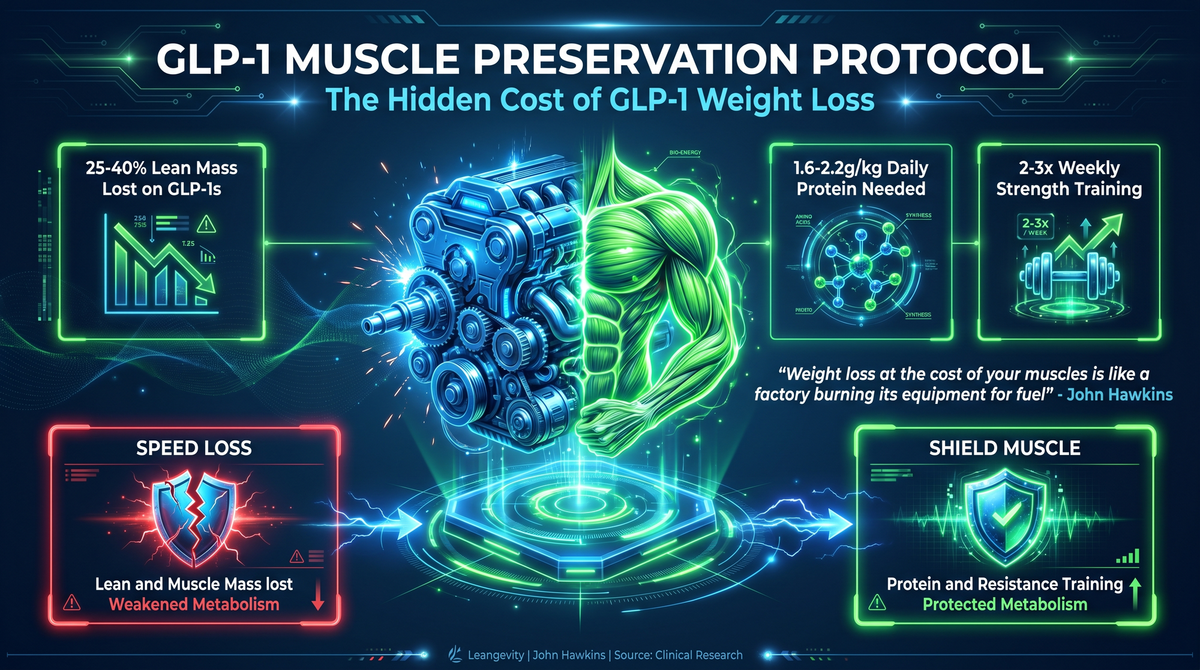
GLP-1s deliver incredible weight loss. But 25-40% of weight lost is lean mass. Here's the data on muscle preservation and what to do about it.
GLP-1 Muscle Loss: New Study Settles the Frailty Debate
Published: April 22, 2026
There's a persistent claim circulating across health media right now: GLP-1 medications cause muscle loss, and that muscle loss will make you frail.
The New York Times ran with it in March 2026. Podcasters have repeated it. It's become the number one objection I hear from people considering GLP-1 therapy.
It sounded plausible. It felt intuitive. Weight loss includes some lean mass loss — that's basic physiology. Therefore, GLP-1s must be turning people into weaker, frailer versions of themselves.
There's just one problem with that reasoning: it's wrong.
A mechanistic study published in Cell Reports Medicine on March 18, 2026 (DOI: S2666-3791(26)00082-0) tested this exact question with two different GLP-1 agents, and the data came back clear. GLP-1-driven weight loss is roughly 70% fat and 30% lean tissue. Muscle function stays intact. And on a relative basis, muscle quality actually improves.
Let's break down what's actually happening metabolically, because the mechanism behind these results is more interesting — and more reassuring — than the headlines suggest.
The Paradox: You Can Lose "Lean Mass" Without Losing Strength
Most people get this wrong because they're conflating two different things: lean body mass and functional muscle tissue.
Lean body mass is a blunt measurement. It includes muscle, water, glycogen, connective tissue, organ mass, and the fluid stored within muscle cells. When you see a DEXA scan report saying "lean mass decreased by 13 percent," that doesn't tell you whether you actually lost contractile muscle fibers — or whether you lost intracellular water and glycogen that happen to be classified as "lean" by the machine.
The authors of the Cell Reports Medicine study put this directly: "Loss of lean body mass is not the same as loss of skeletal muscle."
Here's what they actually found.
The Mechanism: What GLP-1s Do to Body Composition
The study ran two arms — a mouse model and a human pilot. Each tells us something different.
Arm 1: Preclinical Mouse Model (tirzepatide)
Diet-induced obese mice received tirzepatide. Results:
| Metric | Change | |--------|--------| | Total body weight | ↓ 35% | | Fat mass | ↓ 73% | | Lean body mass | ↓ 13% | | Relative muscle mass | Significantly improved (p < 0.05) |
The numbers are striking. Of the total weight lost, approximately 73% came directly from fat. Lean body mass dropped only 13% — a fraction of what the total weight loss would suggest if the loss were distributed proportionally. More importantly, when muscle mass was expressed relative to total body weight (a functionally meaningful ratio), the treated mice significantly outperformed lean controls.
In other words: yes, these mice lost weight. But they didn't lose muscle in proportion to their weight loss. They lost fat. And relative to their new body weight, they had more muscle than they started with.
Arm 2: Human Pilot Trial (semaglutide, 12 weeks)
Ten adults with obesity and type 2 diabetes received semaglutide (1 mg) for 12 weeks. Results:
~70% of total weight loss came from fat mass.
More importantly, functional assessments showed:
- Maximum voluntary contraction (MVC): no statistically significant change from baseline
- Handgrip dynamometry: no statistically significant change from baseline
- Muscle cross-sectional area: slightly reduced (expected with any weight loss)
- Relative strength (strength per unit of body weight): improved
This is the critical finding. Absolute muscle size decreased slightly — consistent with any meaningful weight loss intervention. But the actual capacity of the muscle to generate force did not decline. If anything, functional capacity improved because patients were carrying substantially less body weight.
Think of it this way: a car with the same engine shedding 200 pounds of dead weight doesn't become underpowered. It becomes more responsive.
The Proteomic Evidence: GLP-1s Upregulate Muscle Mitochondrial Proteins
If the strength data wasn't convincing enough, the study went deeper with muscle proteomics — analyzing which proteins were upregulated or downregulated in skeletal muscle tissue under GLP-1 treatment versus matched calorie restriction alone.
The finding is mechanically significant: GLP-1 receptor agonists upregulated mitochondrial proteins in skeletal muscle compared to an equivalent degree of calorie restriction without GLP-1 pharmacotherapy.
Mitochondrial proteins are the engines of cellular energy production. Their upregulation tells us that GLP-1s aren't just passively preserving muscle — they're actively shifting muscle tissue toward a more metabolically efficient state. The muscle becomes better at producing energy per unit of tissue, which helps explain why strength is maintained despite slight reductions in muscle cross-sectional area.
This is not the proteomic signature of a dying tissue. It's the signature of an adaptive one.
Why the "GLP-1 Muscle Loss" Narrative Took Hold
Most people got this wrong because early GLP-1 trials reported changes in "lean body mass" without distinguishing between muscle tissue and other lean components. Health media ran with the lean body mass numbers and readers made the obvious — but incorrect — inference: less lean mass equals weaker muscles.
The data is clear on this: lean body mass reduction does not equal functional muscle loss. The Cell Reports Medicine study is the first to test this claim directly with proteomic and mechanistic data, and it found the opposite of what the narrative predicted.
There's a secondary reason the narrative gained traction. GLP-1s produce rapid weight loss, and rapid weight loss can include muscle loss — particularly in the absence of adequate protein intake and resistance training. If someone loses 40 pounds eating 900 calories a day with zero protein focus and no strength work, they will lose muscle. But that's a dietary failure, not a drug effect. The study compared GLP-1 treatment against matched calorie restriction and still found superior mitochondrial protein preservation with the drug.
What actually causes muscle loss on GLP-1s is what causes muscle loss on any weight loss protocol: insufficient protein. Insufficient resistance stimulus. Excessive caloric deficit. The drug is not the causal variable. The protocol around the drug is.
The Stakes: Why This Matters for the 35+ Population
The concern about GLP-1-induced muscle loss is not irrational — it's misinformed. Muscle mass naturally begins declining around age 30 at a rate of approximately 3–8% per decade, accelerating after 60. Sarcopenia is real, and it's consequential. The question is whether GLP-1 therapy accelerates that decline.
The mechanistic data says no.
Three specific data points from the study support this:
1. Handgrip strength was preserved in the human pilot despite weight loss. Handgrip dynamometry is a validated predictor of all-cause mortality and functional independence in older adults (see: Leong et al., JAMA, 2015). Holding steady on this metric while losing significant weight is a positive outcome, not a neutral one.
2. Relative muscle mass improved. When muscle is expressed as a proportion of total body weight, GLP-1 treated subjects showed improvement. This means the body composition shifted in the right direction: less fat, maintained (or relatively increased) muscle.
3. Mitochondrial proteins were upregulated. This suggests enhanced metabolic health at the cellular level — relevant not just for strength but for endurance, recovery, and long-term tissue viability.
These findings matter most for the demographic that needs GLP-1 therapy the most: adults over 35 with obesity, insulin resistance, or metabolic syndrome. These are the people with the most to lose (literally and figuratively) and the most to fear from muscle decline. The data tells them they don't need to choose between addressing their metabolic health and preserving their physical function. They can do both.
What Actually Preserves Muscle on GLP-1 Therapy
The study answers the mechanistic question: GLP-1s don't inherently cause frailty. But it also points to what does optimize the outcome.
Here's the framework the data supports:
1. Adequate protein intake during active weight loss. Not the RDA. Not "a few more grams." Protein intake needs to scale with the rate of weight loss and the degree of caloric deficit. The exact target depends on body weight, activity level, and metabolic health status — which is precisely why structured coaching around GLP-1 therapy matters.
2. Resistance training stimulus. Muscle adapts to demand in the same direction the demand points. If you stop lifting, muscle assumes it's not needed. If you keep lifting — especially with progressive overload — muscle receives a clear signal: stay functional, stay strong. The GLP-1 handles the appetite and glycemic control. The resistance training handles the muscle preservation. These are not competing mechanisms. They're complementary.
3. Rate of weight loss matters. The study involved clinically meaningful weight reduction. But the proteomic advantage of GLP-1s over matched calorie restriction suggests that a more moderate rate of loss — facilitated by the drug's appetite effects while maintaining adequate nutrition — is more protective than aggressive, unsupervised restriction.
4. Monitoring, not guessing. DEXA scans or equivalent body composition assessments should be part of any GLP-1 protocol. You can't optimize what you don't track. Fat-to-lean ratios, strength benchmarks, and functional assessments provide the data needed to adjust the protocol in real time rather than discovering a problem months after it started.
The Bottom Line
The Cell Reports Medicine study from March 2026 provides the strongest mechanistic evidence available to date that GLP-1 receptor agonists — including semaglutide and tirzepatide — drive weight loss primarily through fat reduction while preserving muscle function. The old "GLP-1 muscle loss equals frailty" narrative was built on a misreading of lean body mass data and hasn't survived contact with actual proteomic and strength data.
Fat loss: ~70% of total weight lost. Muscle function: preserved or improved relative to body weight. Mitochondrial health: upregulated compared to calorie restriction alone.
This doesn't mean GLP-1 therapy is risk-free. It doesn't mean every person will respond identically. It doesn't mean protein intake and resistance training are optional. It means the specific claim that GLP-1s cause frailty through muscle destruction is not supported by the evidence.
The data is clear.
If you're considering GLP-1 therapy and the muscle loss concern has been holding you back, this study should change the risk–benefit calculation. The question isn't whether GLP-1s cause frailty. The question is whether your protocol is structured to protect the muscle you want to keep.
If you'd like a structured approach to GLP-1 therapy that addresses exactly this — body composition monitoring, protein optimization, strength-preserving protocols — our Metabolic Mastery Protocol was designed around this exact problem.
Download the free GLP-1 Companion Guide to start.
Sources:
- Tirzepatide/Semaglutide Muscle Function Study, Cell Reports Medicine (March 18, 2026). DOI: S2666-3791(26)00082-0.
- Leong DP et al., "Prognostic value of grip strength," JAMA (2015).
Leangevity provides metabolic health coaching, not medical treatment. This content is for educational purposes only.