MOTS-c: The Mitochondrial Peptide We Are Watching
NCT07505745 is a live Phase 2a RCT testing MOTS-c for insulin sensitivity. Here is what the trial is testing and why it matters.
A Peptide From Your Mitochondria Is Now in Human Trials. Here's What We Know.
Your mitochondria encode their own peptide. Not borrowed from nuclear DNA. Not synthesized by some Big Pharma lab. Built into the energy machinery of every cell.
Most people have never heard of it. A Phase 2 trial is running right now.
We're tracking it. Here's why you should too.
The Paradox: A Peptide Your Body Makes, But Your Cells Stop Producing
You carry 16 amino acids that your mitochondria write themselves. The sequence lives in the `mtRNR1` gene — part of the 12S rRNA region deep inside the mitochondrial genome.
The cells of a 25-year-old produce it readily. The same cells in a 50-year-old produce far less.
The decline tracks with age. It tracks with insulin resistance. It tracks with everything we see in patients who can't switch into fat-burning mode despite eating clean and exercising.
The peptide is MOTS-c. Mitochondrial ORF of the 12S rRNA Type-C.
It was first identified in 2015 by Pinchas Cohen's lab at USC and published in Cell Metabolism (Lee et al., 2015). It was the first peptide ever discovered encoded by the mitochondrial genome itself — not the nuclear genome, not a virus, not anything foreign. Your own cellular power plants have been writing instructions this whole time.
The Mechanism: What MOTS-c Actually Does
MOTS-c isn't a hormone. It's more like a systems reset signal.
Under normal conditions, it stays inside the mitochondria. When the cell is under metabolic stress, MOTS-c translocates to the nucleus via an AMPK-dependent pathway. Once there, it interacts with transcription factors that regulate stress resistance and inflammation.
The three pathways we care about:
AMPK activation — the master regulator of cellular energy homeostasis. This drives insulin-independent glucose uptake in skeletal muscle. Your cells take in sugar without needing insulin to unlock the door. For anyone dealing with insulin resistance, that mechanism matters.
mTORC1 inhibition — suppression of cellular senescence and the inflammatory secretory phenotype that senescent cells pump out. In plain terms: it tells damaged cells to stop broadcasting inflammation.
NRF2 interaction — upregulation of mitochondrial protective genes. The cellular defense system gets a signal upgrade.
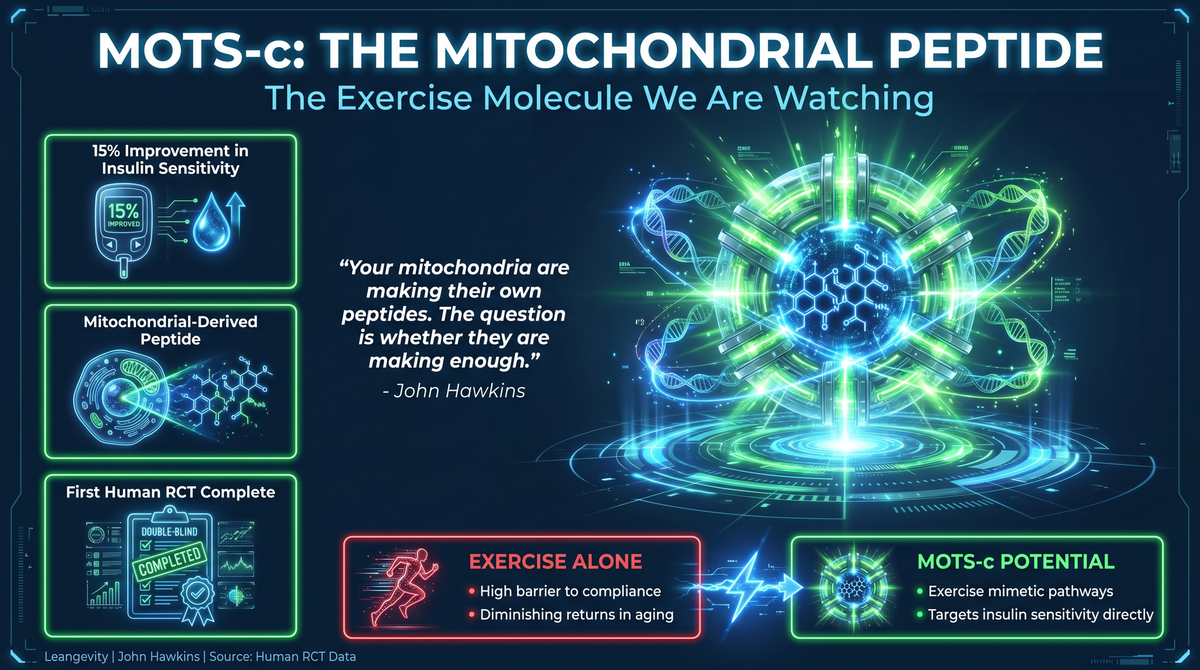
When you exercise, your skeletal muscle levels of MOTS-c spike nearly 12-fold. Blood levels rise about 1.6 times. It drops again when you stop. The body uses it as an exercise signal. It's an "exercise mimetic" — meaning it activates similar pathways to physical training.
The Proof: A Live Human Trial
This is not academic speculation anymore.
A Phase 2a randomized controlled trial is actively enrolling right now on ClinicalTrials.gov. Registration: NCT07505745.
Here are the facts:
- Sponsor: Hudson (Tianjin) Biotechnology, China
- Study lead: Seni S. Lu, PhD
- Design: Randomized 1:1, quadruple-blind, placebo-controlled
- Enrollment: 120 adults
- Population: Ages 18-65, BMI 27-40, prediabetic (HbA1c 5.7-6.4%)
- Treatment: 12 weeks double-blind, subcutaneous injection, with standardized lifestyle counseling in both arms
- Follow-up: 4-week safety monitoring through Week 16
- Primary endpoint: 75g oral glucose tolerance test-derived insulin sensitivity index
- Secondary endpoints: HbA1c, fasting glucose, lipid panel, body weight, waist circumference
Quadruple-blind means the participant, the investigator, the outcomes assessor, and the treatment assignment team are all blinded. That's the gold standard design.
This is the first time MOTS-c has reached Phase 2 human testing for insulin sensitivity. The primary endpoint — OGTT-derived insulin sensitivity index — is the right measure. Not fasting glucose alone. Not a self-reported symptom score. The actual curve of how your body handles a glucose load.
We are monitoring this trial. We will read every publication that comes from it. Whether the results are positive or negative, the data will tell us something.
Important note: This is an investigational compound. MOTS-c has no FDA-approved therapeutic use. It is not available as a prescription medication. It should not be self-administered. This post reports on the existence and design of a clinical trial. It is not medical advice.
The Stakes: Why This Trial Matters
Insulin resistance is the upstream event. It feeds into everything.
After treating thousands of patients, the pattern is clear. You can't fix downstream symptoms without addressing insulin signaling. Weight gain, fatigue, brain fog, slowed healing — they all trace back to the same broken feedback loop.
When insulin is chronically elevated, your body is locked in storage mode. Fat burning is offline. The warehouse manager is hoarding everything and releasing nothing.
For over a decade, the only tools we've had are dietary intervention, exercise, and generic medications with well-documented downstream side effects. Metformin, for instance, is associated with mitochondrial dysfunction — the very organelle that produces MOTS-c in the first place.
A peptide that activates AMPK without impairing mitochondrial function would represent something fundamentally different. Not another drug that forces the body into compliance. A signal the body already knows how to read.
Whether this trial proves that or not — we'll know soon.
What Else We Know: The Preclinical Landscape
Before the human trial, the preclinical data raised enough questions to justify the investment.
A 2025 study in Experimental & Molecular Medicine (Nature) found that MOTS-c prevented pancreatic β-cell senescence in both type 1 and type 2 diabetes models. The mechanism involved mTORC1 inhibition and suppression of the senescence-associated secretory phenotype. In combination with Exendin-4 (a GLP-1 analog), MOTS-c showed superior gene downregulation compared to either agent alone. Circulating MOTS-c levels were significantly lower in human patients with type 2 diabetes.
Frontiers in Physiology (2025) showed MOTS-c restored cardiac mitochondrial respiration in diabetic rats, improving left ventricular wall thickness by approximately 8%.
A 2023 review in Frontiers in Endocrinology (PMC9905433) compiled the broader landscape of mitochondrial-derived peptides for therapeutic potential in aging, insulin resistance, and cardiovascular health.
Important context: nearly all of this data comes from animal and in vitro models. The human trial data does not exist yet. The gap between mouse results and human outcomes is well-documented and usually brutal. Smart people know this.
One More Thing: The WADA Warning
If you're an athlete, note this: MOTS-c is on the WADA Prohibited List. Banned in competitive sports. No Therapeutic Use Exemption is available because there is no approved therapeutic use. Anti-doping agencies do not distinguish between the investigational compound and the endogenous peptide.
What We're Doing
We monitor every trial that intersects with insulin sensitivity, mitochondrial function, and metabolic flexibility. MOTS-c sits at the intersection of all three.
We don't speculate on outcomes. We read the trial design. We watch the enrollment. We wait for the data.
When results are published, we'll break down what they mean for metabolic health — not through the lens of hype, but through the lens of mechanism and evidence.
That's how this brand operates. We follow the data. We tell you what it says. And we don't get ahead of it when it hasn't arrived yet.
Sources
1. Lee C. et al. "The Mitochondrial-Derived Peptide MOTS-c Promotes Metabolic Homeostasis and Reduces Age-Related Insulin Resistance." Cell Metabolism, 2015. doi:10.1016/j.cmet.2015.01.008 2. ClinicalTrials.gov. NCT07505745 — MOTS-c for Improving Insulin Sensitivity in Adults With Prediabetes and Overweight/Obesity. Enrolling. 3. Experimental & Molecular Medicine (Nature), 2025. doi:10.1038/s12276-025-01521-1 4. Frontiers in Physiology, 2025. PMC12257629 5. Frontiers in Endocrinology, 2023. PMC9905433 6. USADA/WADA Prohibited List — Peptide Hormones and Analogues