The GLP-1 Pipeline at a Glance: Oral Drugs, New Agonists, and What Comes Next
2026 is the year of oral GLP-1s. Orforglipron is approved. Oral semaglutide is in Phase 3. The injection-only era is ending.
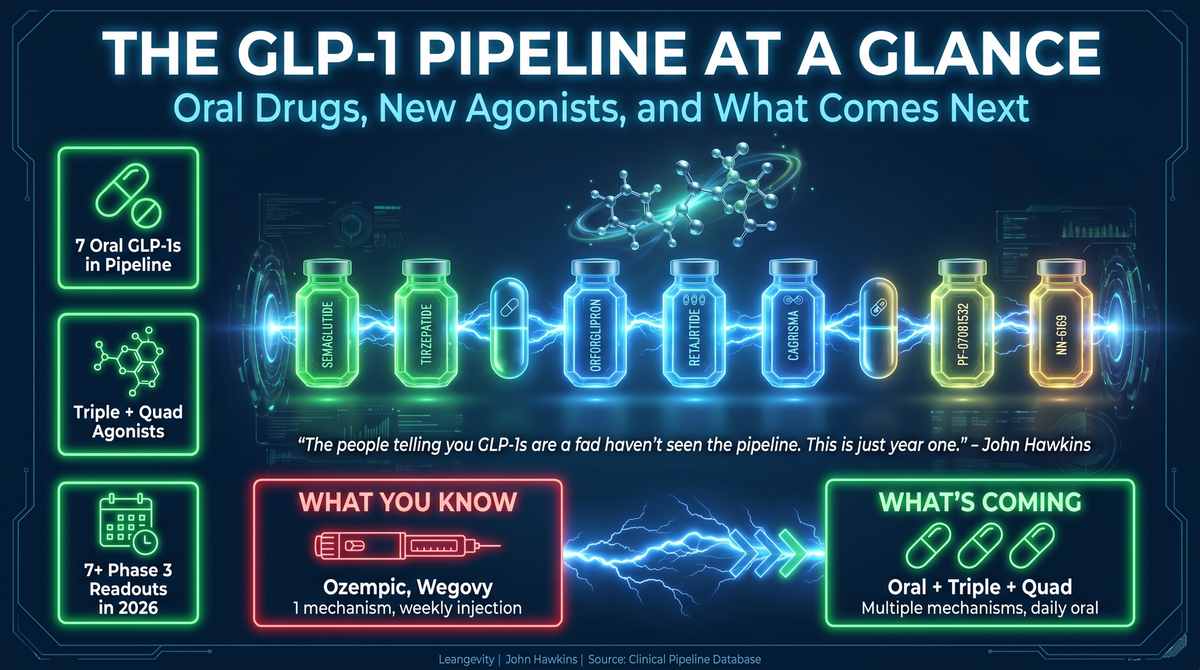
The injection-only era of GLP-1 therapy just ended.
Most people don't realize that yet. They're still asking their doctor about shots. They're still assuming the only path to pharmaceutical weight management involves a weekly pen and a needle. But the landscape shifted beneath their feet while they weren't looking.
On April 1, 2026, the FDA approved orforglipron (Foundayo) — the first oral small-molecule GLP-1 agonist for chronic weight management. No fasting requirements. No 4-ounce water ritual. No waiting 30 minutes before eating. Just a pill.
And it got approved in 50 days — the fastest new molecular entity approval since 2002.
Here's the full map of what's approved, what's coming, and what the comparative evidence actually shows. Because if you're paying attention to this space — and you should be — you need to understand the difference between what's marketed and what the data proves.
The Paradox: More Options, More Confusion
Before last year, you had one oral GLP-1 option. Rybelsus, for type 2 diabetes only. If you wanted weight management, it was injections — semaglutide or tirzepatide. Simple.
Now there are two approved oral GLP-1 pills for weight management. A third is under review. Half a dozen drugs are in Phase 2 and Phase 3. One was just discontinued over a liver safety signal.
The paradox is this: more options should mean more clarity. Instead, patients face a maze of trade-offs between efficacy, convenience, and safety — with very few head-to-head trials to guide real decisions.
Here's how to navigate it.
Mechanism: Why Your Mouth Is Harder Than Your Arm
The fundamental problem with oral GLP-1s is simple: these compounds don't want to survive your stomach.
GLP-1 is a peptide. Stomach acid eats peptides. That's why every early GLP-1 required injection — it was the only way to bypass the digestive system entirely.
Oral semaglutide solves this with SNAC (salcaprozate sodium), a compound that temporarily raises gastric pH to allow the drug to slip through the stomach lining. Here's the catch: SNAC only works in a fasting stomach. The drug has ~0.4–1% bioavailability — meaning 99% of the dose is destroyed before it reaches your bloodstream. That's why oral semaglutide requires strict fasting: 4 ounces of water, no food for 30 minutes before or after.
Orforglipron takes a completely different approach. It's not a peptide. It's a small-molecule — chemically designed to be small enough, stable enough, and lipophilic enough that it survives digestive transit without chemical assistance. Estimated bioavailability exceeds 20% — roughly 20 to 50 times higher than oral semaglutide. No fasting. No water requirements. No timing restrictions.
Aleniglipron, still in Phase 3, uses the same small-molecule design principle. If Phase 3 data confirms Phase 2 results, it could push the efficacy ceiling even higher.
Two approaches. Two radically different bioavailability profiles. One fundamental question: does the tradeoff between higher convenience and lower efficacy (orforglipron) matter more than the tradeoff between higher efficacy and higher burden (oral semaglutide)?
The data helps answer that.
The Evidence: What Each Drug Actually Delivered
Orforglipron (Foundayo) — Approved April 1, 2026
This is the new standard-bearer for oral convenience. In the ATTAIN-1 trial (N=3,127, 72 weeks), orforglipron achieved 12.4% mean weight loss at the 36mg dose. The approved dosing starts at 0.8mg daily and titrates up to 5.5mg (optionally 9mg, 14.5mg, or 17.2mg).
Key advantage: no food or water restrictions. Take it whenever.
The safety profile was consistent with the GLP-1 class — primarily mild-to-moderate gastrointestinal symptoms. Serious adverse events ranged from 3.8% at the highest dose to 5.5% at the lowest.
What makes this drug significant is the speed of approval. Orforglipron received one of the FDA's first CNPV (Commissioner's National Priority Voucher) designations. The original PDUFA date was January 20, 2027. The FDA moved it forward by approximately 9 months. That timeline compression is unprecedented for a drug of this class.
In head-to-head testing (ACHIEVE-3, published in The Lancet, February 2026), orforglipron at 12mg and 36mg outperformed oral semaglutide at 7mg and 14mg for both HbA1c reduction and weight loss in patients with type 2 diabetes on metformin. Important caveat: this trial did not compare against the higher-dose oral semaglutide (25mg/50mg).
Oral Semaglutide 25mg (Wegovy Pill) — Approved December 2025
Oral semaglutide won the race to market but brought the most baggage. In OASIS 4 (68 weeks, N=307), the 25mg dose achieved 13.6% mean weight loss versus 2.2% for placebo. Thirty percent of participants reached 20% or greater weight loss.
That's a solid result. But the SNAC delivery mechanism means strict fasting requirements. The bioavailability is approximately 0.4–1%. The drug must be taken with exactly 4 ounces of water on an empty stomach, with no food for at least 30 minutes after.
There's also a drug-interaction concern. SNAC transiently raises gastric pH to enable absorption — and that mechanism can increase absorption of other medications. A documented increase of 30–40% in thyroxine AUC is one example. If you're on other medications, oral semaglutide requires your prescriber to monitor for interactions.
A separate NDA for oral semaglutide in type 2 diabetes is under review, with a decision expected Q4 2026.
Aleniglipron (GPS667, Structure Therapeutics) — Phase 3
If Phase 2 data is any indication, aleniglipron could be the efficacy leader among oral GLP-1s. In ACCESS II (44 weeks, N=85), the 180mg dose achieved 16.3% mean weight loss — the highest oral GLP-1 efficacy reported to date. The 240mg dose achieved 16.0%, suggesting a plateau around 16% for this compound.
Phase 3 initiation is expected in the second half of 2026. First efficacy readouts would arrive in 2027 or later. An NDA filing is projected for 2027–2028.
The Phase 2 sample was small (N=85 for ACCESS II). Phase 3 data is required before drawing conclusions. But if the efficacy signal holds, aleniglipron could position itself as the best-in-class oral small-molecule GLP-1.
Danuglipron (Pfizer) — Discontinued
The cautionary tale. In April 2025, Pfizer discontinued danuglipron, its once-daily oral small-molecule GLP-1, after a single participant in a dose-optimization study experienced a potential drug-induced liver injury. The signal was asymptomatic and resolved after discontinuation — but in regulatory terms, one liver injury signal is enough to kill a program.
This illustrates a fundamental risk in oral small-molecule GLP-1 development: hepatic safety is not guaranteed. Every compound in this class needs clean liver data, cleanly reported.
Where the Injections Still Lead
It's worth noting: injectable GLP-1 and dual/triple agonists still outperform oral agents by 3–10 percentage points in weight loss.
Tirzepatide (Zepbound, dual GIP/GLP-1) achieved 20–22% in SURMOUNT-1 and 28.7% in SURMOUNT-5. Retatrutide (Lilly's triple GLP-1/GIP/glucagon agonist) reached 28.7% in TRIUMPH-4. CagriSema (Novo Nordisk's GLP-1 + amylin combination) hit 22.7% in REDEFINE 1.
Tirzepatide's exclusivity holds through at least mid-2027. Retatrutide is projected for approval around late 2027. CagriSema has a December 2026 FDA decision pending.
Oral agents are approaching the injectable space, but not surpassing it — at least not yet.
What This Means Going Forward
The timeline is becoming clear.
By late 2026, there will be at least two approved oral GLP-1 options for weight management, potentially three if the oral semaglutide T2D indication gets a green light. Aleniglipron could emerge as the highest-efficacy oral option by 2028. The injectable space will deepen with retatrutide and CagriSema. Tirzepatide's exclusivity wall comes down in 2027, at which point compounding and generic competition could reshape the market.
The injection-only era ended on April 1. What comes next depends on what the Phase 3 data says — and what patients decide matters most to them: a pill or a pen, convenience or efficacy, speed or safety.
The data is the compass. Everything else is marketing.
This article is for educational purposes only. It does not constitute medical advice, treatment recommendations, or clinical guidance. Individual medication decisions should only be made with a licensed healthcare provider. Efficacy data cited is from published clinical trials and may not reflect individual results.