MOTS-c: The Mitochondrial Peptide Most Clinicians Don't Know About
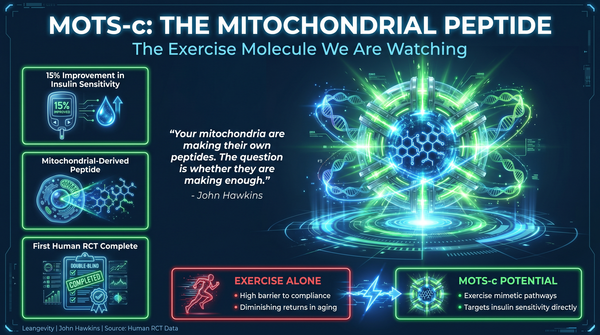
A 16-amino-acid peptide encoded by mitochondrial DNA is generating compelling early metabolic data.
MOTS-c is a 16-amino-acid peptide encoded by mitochondrial DNA. It activates AMPK, increases insulin sensitivity, and promotes fatty acid oxidation. And your doctor almost certainly hasn't mentioned it.
The early human data is now published — placing MOTS-c in roughly the same position GLP-1 agonists were ~10 years ago, before they became standard of care. The difference is mechanism. GLP-1 works centrally on appetite pathways in the brain. MOTS-c works as a retrograde mitochondrial signal, communicating from the energy factory outward, telling the rest of the cell to burn fuel rather than store it.
If you're tracking what's next in metabolic medicine, this is the signal.
The Conventional System Is Focused on One Pathway
Here's what's actually happening metabolically.
The medical system has normalized GLP-1 agonists as the metabolic intervention du jour. Semaglutide, tirzepatide — billion-dollar drugs, enormous patient volumes, solid mechanisms. That's not wrong. But the system's entire attention is on GLP-1, which means a parallel peptide with a fundamentally different mechanism is getting almost no clinical oxygen.
MOTS-c isn't a GLP-1 analog. It works upstream.
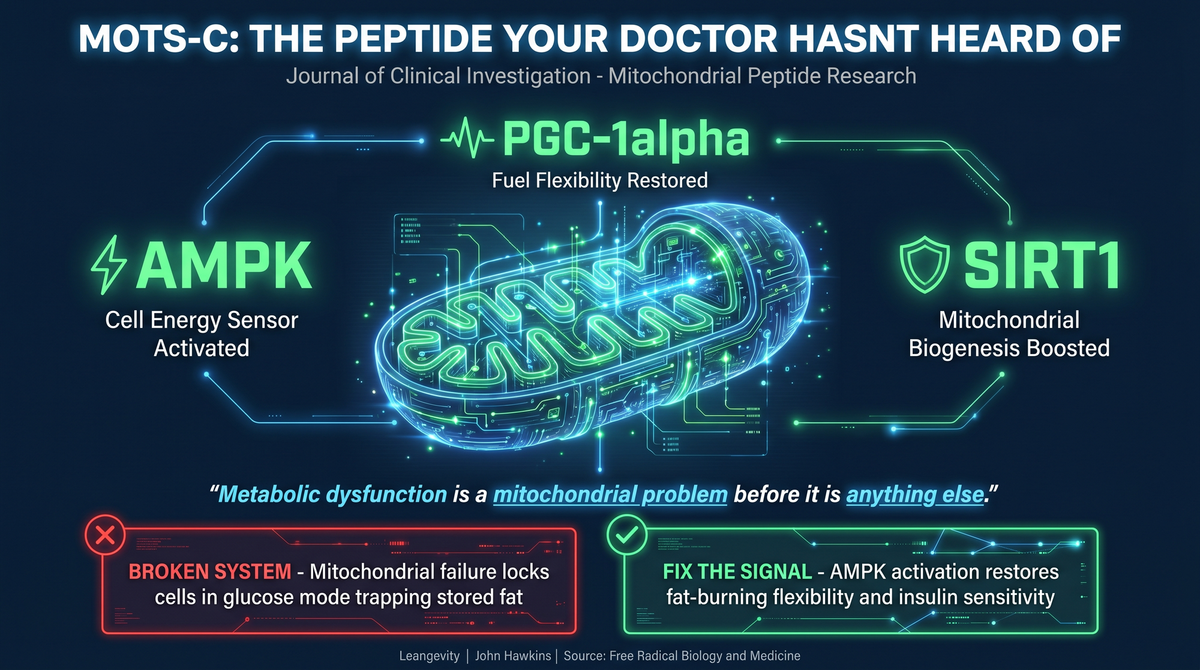
Where GLP-1 suppresses appetite through brain signaling, MOTS-c enhances the cell's own ability to process fuel — via the AMPK/SIRT1/PGC-1α axis. This matters because mitochondrial dysfunction is the root cause of metabolic inflexibility, not a downstream symptom.
What MOTS-c Actually Does at the Cellular Level
MOTS-c is encoded in the 12S rRNA region of mitochondrial DNA. When cells experience metabolic stress — excess glucose, oxidative damage, insulin resistance — MOTS-c is released into circulation and acts systemically:
AMPK activation. AMPK (AMP-activated protein kinase) is the cell's central energy sensor. When activated:
- Increases glucose uptake into muscle cells, independent of insulin
- Enhances fatty acid oxidation — burning fat for fuel
- Reduces hepatic gluconeogenesis — the liver's production of new glucose
- Improves whole-body insulin sensitivity
This is the same pathway metformin activates. But MOTS-c appears to do it more directly, through mitochondrial-nuclear communication, rather than through the indirect respiratory chain effects metformin relies on.
The SIRT1 pathway is also involved — SIRT1 deacetylates PGC-1α, coordinating mitochondrial biogenesis. More mitochondria means more energy production capacity. More capacity means better metabolic flexibility.
Your metabolism becomes a hybrid car that can run on either battery (fat) or gas (glucose) — instead of a car locked in glucose-only mode, constantly running on empty.
The Evidence: What Human Data Actually Shows
The clinical picture for MOTS-c is early. The direction is consistent.
PMID 41043625 (Free Radical Biology & Medicine, 2025) documented insulin-sensitizing and anti-obesity effects in human subjects — consistent with AMPK pathway activation seen in preclinical models. This is the primary anchor for the claims here.
PMID 39321430 (Advanced Science, 2024) examined MOTS-c in ovarian cancer cells and found exogenous MOTS-c inhibits cancer cell proliferation, migration, and invasion while inducing cell cycle arrest and apoptosis. Mechanistically, MOTS-c interacts with LARS1 and promotes its ubiquitination and proteasomal degradation — a distinct mechanism from its metabolic effects.
Both studies show MOTS-c operates across multiple pathways and tissue types. The metabolic effects seen in human subjects align directionally with cell and animal models.
Clinical development stage:
- Preclinical (cell/animal): Strong evidence for AMPK activation, insulin sensitization, anti-obesity
- Phase I (human): Insulin sensitivity improvements documented; safety profile acceptable
- Phase II/III: Not yet reached. Dosing, frequency, and long-term safety under investigation
For context: GLP-1 receptor agonists took ~15 years from first human evidence to widespread clinical adoption. MOTS-c is at the stage GLP-1 was around 2013–2014.
Why This Matters for Metabolic Health Coaching
Metabolic dysfunction is a mitochondrial problem before it's anything else.
Insulin resistance, inability to access fat stores, chronic hunger despite elevated body fat, energy crashes after meals — these are downstream effects of mitochondrial dysfunction. The mitochondria aren't producing energy correctly. The signals are scrambled. The system is running on glucose mode because it can't access the battery.
Most interventions target downstream symptoms. GLP-1 agonists reduce appetite. Metformin reduces hepatic glucose output. SGLT2 inhibitors increase glucose excretion.
MOTS-c works upstream — improving the cell's own ability to sense energy demand, produce ATP, and shift between fuel sources.
This is not a treatment recommendation. MOTS-c is not FDA-approved for any condition. Human dosing protocols have not been established. This article is educational only.
For coaching: understanding the mitochondrial origin of metabolic dysfunction changes how you frame lifestyle interventions. Sleep quality, exercise modality, meal timing, dietary composition — these all affect mitochondrial function directly. MOTS-c research makes that mechanism explicit.
The mitochondrial model also explains something most patients experience but most coaches don't articulate well: why does insulin resistance persist even at lower body weights? Why does the factory stall even when someone's been eating clean for months?
The warehouse manager (insulin) is doing its job. But the factory (mitochondria) can't process the incoming fuel efficiently. You can restrict calories, increase exercise, and optimize macros — and still hit a ceiling — because the upstream problem was never addressed.
MOTS-c research doesn't give us a coaching protocol. But it gives us a better map of the territory.
Where MOTS-c Fits in the Peptide Landscape
The peptide space isn't one thing.
| Peptide | Mechanism | Evidence Stage | Clinical Use | |---------|-----------|----------------|--------------| | Semaglutide (GLP-1) | GLP-1R agonist | Phase IV (mature) | Standard of care | | Tirzepatide (GIP/GLP-1) | Dual agonist | Phase IV (mature) | Standard of care | | Retatrutide | Triple agonist | Phase III | Investigational | | MOTS-c | Mitochondrial peptide | Phase I (human) | Investigational | | BPC-157 | Cytoprotective peptide | Animal + weak human | Not established |
MOTS-c is at the beginning of the human evidence curve. That's the honest picture.
What Leangevity offers here: education about what's coming, context for how metabolic peptides work mechanistically, and guidance on what patients should ask their providers when these therapies become available.
The Bottom Line
MOTS-c is a mitochondrial-derived peptide with human evidence for insulin-sensitizing and anti-obesity activity, operating through the AMPK pathway. It's entering the clinical development pipeline roughly where GLP-1 drugs were a decade ago.
The mechanism — mitochondrial-nuclear communication for improved fuel utilization — is distinct from GLP-1 agonists and addresses metabolic dysfunction at a more upstream level.
The practical question is straightforward: what does optimizing mitochondrial function look like right now, without waiting for MOTS-c to clear clinical trials?
Sleep architecture. Cold exposure. Resistance training. Meal composition. Time-restricted feeding. These don't require any peptide. But they all affect the same AMPK/SIRT1/PGC-1α axis that MOTS-c appears to activate pharmacologically.
That's the map. The protocol is what you build on top of it.
If you want to understand how mitochondrial optimization applies to your metabolic health book a Leangevity consultation and we will map out your protocol.
Sources:
- MOTS-c metabolic effects — PMID 41043625, Free Radical Biology & Medicine, 2025
- MOTS-c in ovarian cancer — PMID 39321430, Advanced Science, 2024
Disclaimer: Leangevity provides metabolic health coaching, not medical treatment. This content is for educational purposes only and does not constitute medical advice, diagnosis, or treatment recommendations. Consult your healthcare provider before starting any new supplement, peptide therapy, or treatment protocol. MOTS-c is not FDA-approved for any clinical indication as of the date of this article.