Retatrutide: The Triple Agonist That Makes GLP-1s Look Basic
Eli Lilly's retatrutide achieved 28.7% weight loss and 76% knee pain reduction in Phase 3. Seven more readouts coming in 2026.
Retatrutide: The Three-Receptor Drug That Just Broke Every Phase 3 Record
The most effective weight-loss drug ever tested in a Phase 3 trial doesn't hit one receptor. It doesn't hit two.
It hits three.
And the difference between two and three isn't incremental. It's structural.
The Paradox: More Receptors, More Results, More Questions
Semaglutide proved GLP-1 alone could deliver roughly 15% weight loss. The market called it a revolution.
Tirzepatide added a second receptor — GIP. Weight loss jumped to 22%. The market called that a revolution too.
Now Eli Lilly has published Phase 3 data on a drug that adds a third receptor — glucagon — and the ceiling just disappeared.
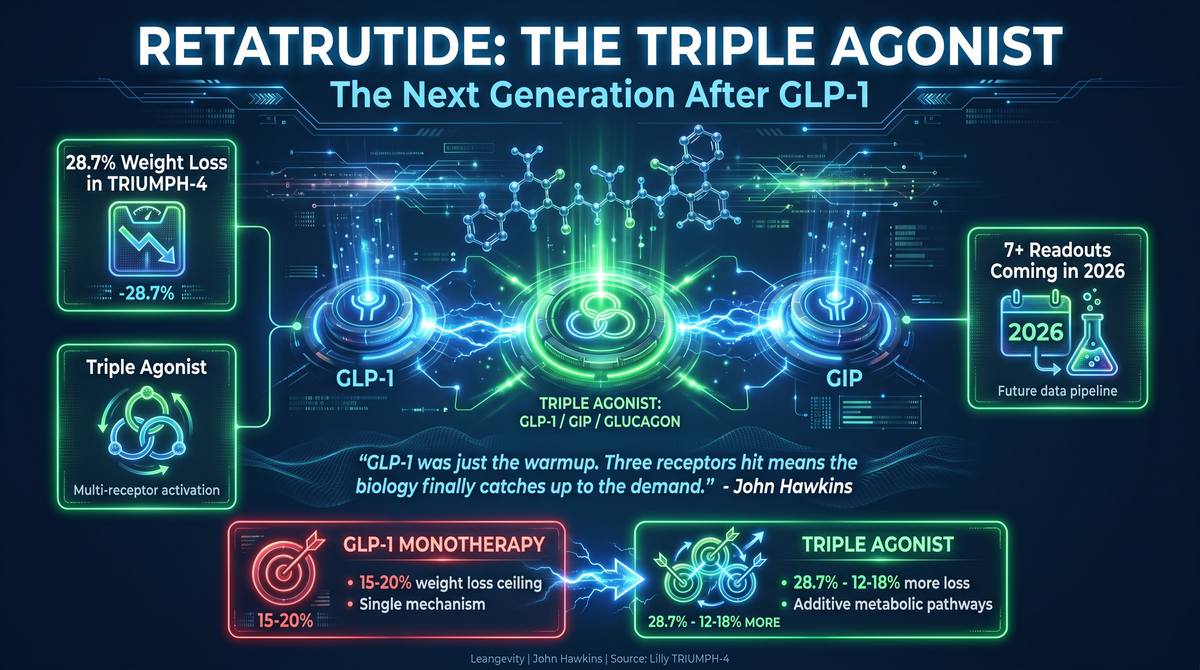
Twenty-eight point seven percent. That's the mean weight loss number from the TRIUMPH-4 trial. On average, patients lost 71.2 pounds over 68 weeks. Placebo got them 2.1%.
The math is straightforward. The mechanism is where it gets interesting.
The Mechanism: What the Glucagon Piece Actually Does
Most people understand the appetite side. GLP-1 slows gastric emptying and signals fullness. GIP enhances glucose handling and modulates insulin response. These are the two receptors Wegovy and Zepbound already target.
The third receptor — glucagon — is what changes the equation.
Glucagon doesn't suppress appetite. It increases energy expenditure. It signals the liver to burn stored fat. It drives hepatic lipid oxidation and promotes PCSK9 degradation, which increases LDL receptor recycling and drops circulating cholesterol.
Appetite suppression is only half the battle. Energy expenditure is the other half. And dual agonists don't have this lever.
Think of it like a hybrid car stuck in gas mode. GLP-1 and GIP reduce the fuel going in. That helps. But glucagon unlocks the valve on the massive battery pack of stored fat sitting unused. Now you're also burning what's already in the tank.
The downstream effects are measurable.
The Proof: TRIUMPH-4 and the Numbers Nobody Saw Coming
The TRIUMPH-4 Phase 3 trial enrolled 445 adults with obesity and knee osteoarthritis — no diabetes. Randomized, double-blind, placebo-controlled.
The 12 mg dose results:
Weight loss: −28.7% mean reduction (−32.3 kg / −71.2 lbs) at 68 weeks. Nearly 40% of patients hit 30% body weight loss or more. Placebo: 0.8% reached that threshold.
Knee osteoarthritis pain: 76% relative reduction in WOMAC pain scores. Fourteen percent of patients became completely pain-free. The placebo group saw less than half that improvement.
Blood pressure: Systolic BP dropped 14.0 mmHg.
Metabolic reversion: 72% of patients with prediabetes reverted to normal blood sugar.
Lipids: Significant reductions in non-HDL cholesterol and triglycerides — the glucagon-driven PCSK9 effect in action.
Every co-primary endpoint was met. This isn't a margin-of-error story.
The Phase 2 Foundation: A Liver Fat Result That Still Defies Belief
Before Phase 3, the Phase 2 trial published in NEJM (Jastreboff et al., 2023, PMID: 37672789) showed a different kind of headline: liver fat.
At 48 weeks, the 12 mg dose reduced liver fat by 86%. Ninety-three percent of participants achieved normal liver fat levels (below 5%). This remains the largest pharmacological liver fat reduction ever recorded for MASLD/MASH.
The Phase 2 weight loss trajectory is equally instructive. At 48 weeks, patients hit 24.2%. The curves hadn't plateaued. TRIUMPH-4 simply let the drug run another 20 weeks and the number climbed to 28.7%.
If you're following the trajectory, the math is clear: weight loss continued. It didn't stall.
Retatrutide vs. the Duals: The Network Meta-Analysis
A 2025 network meta-analysis published in the Journal of the Endocrine Society (SUN-659) compared retatrutide directly against tirzepatide across 12 trials. The numbers are indirect comparisons — not head-to-head data, which hasn't been published yet — but they're the best apples-to-apples we have right now.
Retatrutide mean weight difference: −16.34 kg versus −11.82 kg for tirzepatide. P-value under 0.0001.
Percentage weight loss: −23.77% for retatrutide versus −16.79% for tirzepatide. Same significance level.
Head-to-head (TRIUMPH-5, NCT06662383) is enrolling. Until that reads out, the network data is the reference point.
TRANSCEND-T2D-1: It Works in Type 2 Diabetes Too
In March 2026, Lilly reported TRANSCEND-T2D-1 — 537 adults with type 2 diabetes, 40 weeks, four arms.
HbA1c dropped 1.7 to 2.0 percentage points with retatrutide versus 0.8 with placebo. Weight loss ranged from 11.5% to 16.8% versus 2.5% on placebo. All key secondary endpoints met.
This matters because it confirms the mechanism works across two distinct populations. Obesity without diabetes. And obesity with diabetes. Same lever, both sides of the fence.
The Safety Profile: What to Expect
Let's be direct about the adverse events.
In TRIUMPH-4 at the 12 mg dose:
- Nausea: 43%
- Diarrhea: 33%
- Constipation: 25%
- Vomiting: 21%
- Decreased appetite: 18%
These are GI events consistent with the incretin class. Semaglutide and tirzepatide carry similar categories. The rates at 12 mg are somewhat higher than what those drugs show in their respective trials.
Discontinuation due to adverse events: 18.2% at 12 mg, 12.2% at 9 mg, 4.0% on placebo. The higher BMI patients tolerated the drug better than lower BMI patients — a pattern worth noting.
There's also a novel signal: dysesthesia — abnormal skin sensation — appeared in 20.9% of 12 mg patients versus 0.7% on placebo. It's mostly mild, rarely led to discontinuation, and appears linked to the glucagon receptor. Nothing else in this drug class causes it. This is unique to triple-agonist mechanism.
The T2D population saw lower discontinuation overall — 2.2% to 5.1% — and lower dysesthesia rates at 2.3% to 4.5%.
No clinically significant hypoglycemia in non-diabetics. No pancreatitis signal above background. Heart rate increased slightly — a known GLP-1 class effect.
The Maintenance Question: Will You Stay on 12 mg Forever?
This is the question every patient asks. And Eli Lilly is already running an answer.
A 4 mg maintenance dose is being tested as an add-on cohort within the TRIUMPH-1 master protocol. The hypothesis: after achieving 25-28% weight loss during the titration and target-dose phases, stepping down to 4 mg weekly can maintain that loss without the sustained GI burden of 9-12 mg.
Five hundred patients. Twenty-four week extension. If validated, this gives physicians a formalized maintenance protocol instead of the current anecdotal management with existing GLP-1s.
What's Coming: Seven More Phase 3 Readouts in 2026
The 2026 pipeline for retatrutide is dense. Seven additional Phase 3 trials are completing this year:
- TRIUMPH-1 — General obesity, 2,300+ patients, five doses plus the 4 mg maintenance cohort
- TRIUMPH-2 — Obesity with type 2 diabetes
- TRIUMPH-3 — Obesity with established cardiovascular disease
- TRIUMPH-SLEEP/OSA — Obesity with obstructive sleep apnea
- TRIUMPH-LIVER/MASLD — MASLD/MASH with liver fibrosis
- Chronic Low Back Pain — Obesity plus chronic low back pain
- Dose Escalation Optimization — 500-patient titration protocol study
The cardiovascular outcomes trial — 10,000 patients, 5-year follow-up — reads in the late 2020s. That's the one that will determine real-world clinical positioning.
The Timeline: When Will Patients Actually Get This Drug?
NDA filing is projected for Q4 2026 to Q1 2027. Standard FDA review is 10 months. Priority review is 6 months.
Best case: mid-2027 approval, commercial launch by Q1 2028.
Projected global sales peak: $15.6 billion by 2031, across a global obesity market valued at $206.5 billion.
If you're a patient currently on semaglutide or tirzepatide, this is not a wait-and-see play. The timeline is 18-24 months out from today. Continue your current protocol. Optimize your nutrition. Build metabolic flexibility now. The drug landscape will look different when retatrutide arrives. The fundamentals — diet quality, insulin management, metabolic health — won't change.
The Bottom Line
Retatrutide isn't just another step on the incretin ladder. The glucagon receptor is a different mechanism entirely. It converts stored fat into energy. It clears liver fat. It drops cholesterol through PCSK9 degradation. It increases energy expenditure instead of just suppressing appetite.
The data supports the mechanism. The mechanism explains the data.
The drug is investigational. It is not FDA approved. It is available only through clinical trials. The safety profile is real, and the discontinuation rates are higher than current options. But the trajectory from Phase 2 to Phase 3 is clear, and seven more Phase 3 readouts are coming in 2026.
The triple-agonist era is starting. The clinical architecture of obesity treatment is about to look very different from what it does today.
Disclaimer: Retatrutide (LY3437943) is an investigational medication and is not approved by the FDA or any regulatory agency. This content is for educational and coaching purposes only. It does not constitute medical advice, clinical recommendations, or a substitute for consultation with a healthcare provider. Do not stop or change any current medication or protocol without discussing with your doctor. Results from clinical trials represent study populations under controlled conditions and do not guarantee individual outcomes.
Sources
1. Eli Lilly PR, Dec 11, 2025 — TRIUMPH-4 topline results 2. Jastreboff et al., 2023, NEJM — Phase 2 obesity trial (PMID: 37672789) 3. Jastreboff et al., 2023, Lancet — Phase 2 T2D trial (PMID: 37672788) 4. Salhab et al., 2025, J Endocrine Society (SUN-659) — Network meta-analysis (PMC12544991) 5. Eli Lilly PR, Mar 2026 — TRANSCEND-T2D-1 topline results 6. TCTMD, Mar 19, 2026 — TRANSCEND-T2D-1 coverage 7. PMC11486854 — NIH Retatrutide mechanism review 8. Heimbach et al., 2025/2026, Diabetes Obesity & Metabolism — TRIUMPH registrational trial design (PMID: 41090431) 9. ClinicalTrials.gov — NCT05931367, NCT05929066, NCT06354660, NCT06662383, NCT07232719 10. ParaHealth, 2026 — TRIUMPH program overview